An artificial intelligence call center uses AI technologies to support (and in some cases automate) common contact center workflows. The goal is simple: help customers faster, help agents perform better, and help businesses scale service without sacrificing quality. AI can power self-service for routine questions, assist human agents in real time during complex calls, and unlock insights from conversations that were previously hard to analyze at scale.
Modern call centers increasingly rely on AI to streamline operations, improve customer satisfaction, and reduce agent workload. AI contact center automation and engagement combines speech recognition for transcribing calls, natural language processing for understanding intent, machine learning for routing and prediction, and generative AI for drafting responses and summaries. An AI omnichannel contact center solution ensures these tools work seamlessly across all communication channels, reducing wait times, improving consistency, and freeing agents to focus on high-value conversations.
Evaluating artificial intelligence call center pricing is important when planning adoption. Costs can vary based on features, number of agents, interaction volumes, and integrations. Understanding pricing upfront helps organizations invest wisely and get measurable improvements in customer experience and agent efficiency.
What makes a call center “AI-powered”?
An AI-powered call center is not a single tool; it is an operating model where intelligence and automation are embedded across the customer journey, demonstrating the value of ai call center software. This includes:
- Before the call: Predicting intent and routing customers to the right queue
- During the call: Agent assistance, compliance prompts, and knowledge retrieval
- After the call: Automated summaries, follow-ups, and analytics
This approach ensures AI technology shapes customer experience and consistently improves outcomes across the entire interaction.
Common AI components in an artificial intelligence call center
- Virtual agents for voice and chat to handle repetitive questions and transactional requests.
- Intelligent routing that matches customers to the best agent or queue based on intent, sentiment, language, or customer profile.
- Real-time transcription and call summarization to reduce after-call work.
- Agent assist tools that surface knowledge base articles, recommended next steps, and suggested phrasing during live interactions.
- Quality management automation that scores more interactions than a manual sampling process can cover.
- Workforce optimization signals such as forecasting support volume and identifying drivers of repeat contacts.
Not every organization implements all components at once. Many begin with high-impact areas such as summarization and routing, then expand over time to create fully integrated ai call center capabilities, illustrating why modern ai call center solutions increasingly rely on AI to deliver intelligent, efficient, and consistent customer support.
Top Artificial Intelligence Call Center Solutions
Artificial intelligence call centers leverage AI, machine learning, natural language processing, and automation to enhance customer service, optimize agent performance, and reduce operational costs. These solutions provide omnichannel support, automate routine interactions, and generate actionable insights for enterprises. Here are some of the leading AI call center solutions:
1. Bright Pattern — Enterprise AI Call Center Solution

Bright Pattern provides a robust AI call center platform built for enterprises that require scalability, automation, and omnichannel customer engagement. Its solution helps organizations improve first-contact resolution, reduce operational costs, and deliver superior customer experiences.
Key Features and Commercial Benefits:
- Automated virtual agents handle FAQs, billing inquiries, order tracking, appointment scheduling, and returns, reducing the workload for live agents.
- Intelligent routing connects customers with the most appropriate agent based on skills, sentiment, and history.
- Omnichannel support allows seamless communication across voice, chat, SMS, email, messaging apps, and video.
- Real-time agent assistance provides suggested responses, knowledge articles, next-best actions, and sentiment insights during live interactions.
- Workflow automation reduces repetitive tasks such as ticket creation, follow-ups, notifications, and surveys.
- Predictive analytics tracks interaction trends, customer sentiment, and agent performance to optimize staffing and processes.
- Integration services connect with CRM, workforce management, and marketing platforms, leveraging existing technology investments.
- Proactive engagement automates notifications for service updates, promotions, or delays, reducing inbound contacts.
- Enterprise scalability and security provide global compliance, disaster recovery, and data protection.
- Commercial ROI: Enterprises using Bright Pattern report lower call handling times, higher customer satisfaction, and measurable cost savings, making it a top choice for large-scale operations.
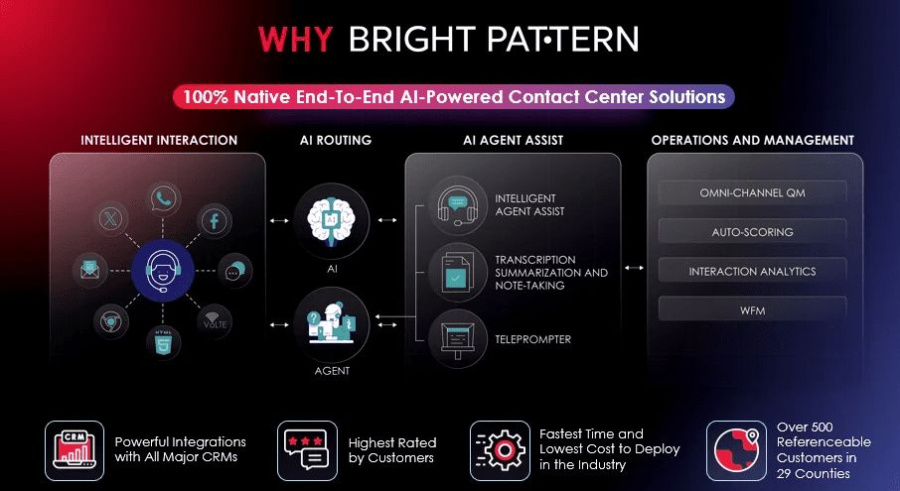
Bright Pattern is trusted by healthcare, finance, retail, and telecom enterprises for intelligent, automated, and commercially optimized AI call center solutions.
2. Aspect AI Call Center Solutions
Aspect offers AI-powered call center solutions including intelligent routing, virtual agents, and workflow automation. Enterprises can automate routine tasks, improve first-contact resolution, and optimize customer experiences.
3. NICE CXone AI Call Center Solutions
NICE CXone combines AI automation, workforce optimization, and real-time coaching to enhance agent performance, reduce handling times, and maintain consistent service quality.
4. LivePerson AI Call Center Solutions
LivePerson provides AI-powered chatbots, virtual agents, and real-time agent guidance, helping businesses automate repetitive tasks and deliver better customer support.
5. Amazon Connect AI Call Center Solutions
Amazon Connect uses AI technologies such as Amazon Lex and Contact Lens for virtual agents, sentiment analysis, speech-to-text, and enterprise-scale automation.
6. Talkdesk AI Call Center Solutions
Talkdesk provides AI virtual agents, workflow automation, and real-time agent assistance to enhance call resolution speed and optimize staffing.
7. Zendesk AI Call Center Solutions
Zendesk automates ticket routing, conversational bots, and knowledge base recommendations, reducing agent workload and improving resolution times.
8. Microsoft Dynamics 365 AI Call Center Solutions
Microsoft Dynamics 365 provides AI-assisted call routing, virtual agent support, and predictive insights for efficient, personalized customer service.
9. Salesforce Service Cloud + Einstein AI Call Center Solutions
Salesforce Einstein integrates AI into Service Cloud for intelligent routing, workflow automation, predictive recommendations, and agent guidance, improving enterprise efficiency and satisfaction.
10. Five9 AI Call Center Solutions
Five9 delivers AI-powered virtual agents, smart IVR, and real-time agent assistance, automating routine interactions and optimizing enterprise contact center operations.
Top benefits of an artificial intelligence call center
AI helps call centers improve outcomes that matter to customers and to operations leaders. The biggest wins usually show up in speed, consistency, and scalability.
1) Faster service and shorter wait times
AI can reduce time-to-resolution by automatically collecting information (like order numbers or account verification details) and routing customers to the right destination. Virtual agents can also handle high-volume, repeatable questions instantly, which can reduce queue pressure for human agents.
2) More consistent answers across channels
Customers expect the same quality whether they call, chat, or message. AI-powered knowledge retrieval and guided workflows help standardize responses, ensuring policy-aligned answers without requiring every agent to memorize every detail.
3) Improved agent productivity and morale
Agents spend significant time on after-call work: documenting, tagging, and writing summaries. AI summarization can dramatically reduce this load, giving agents more time to focus on customers. Real-time assistance can also lower stress by helping agents find accurate information quickly.
4) Better quality monitoring at scale
Traditional quality assurance often relies on reviewing a small sample of calls. AI can analyze a much larger share of interactions, making coaching more data-driven and enabling earlier detection of issues such as process gaps, training needs, or confusing policies.
5) Actionable customer insights from conversations
Contact centers capture a goldmine of customer feedback. AI can group themes (for example, repeated complaints about a feature) and highlight trends in sentiment, reasons for contact, and friction points. That insight can guide product improvements, policy updates, and proactive communications.
Where AI fits in the customer journey
AI value increases when it is applied end-to-end rather than in isolated pockets. The sections below outline how it can support each stage.
Before the interaction: smarter entry and routing
- Intent detection from IVR prompts, web forms, or chat openings.
- Customer context pulled from CRM or order systems to reduce repetitive questions.
- Predictive routing to match customers with agents likely to resolve issues quickly.
During the interaction: real-time support
- Live transcription for searchable context and accessibility.
- Agent assist recommendations for policies, troubleshooting steps, or offers.
- Compliance cues that remind agents of required disclosures in regulated scenarios.
After the interaction: automation and learning loops
- Call summaries and structured wrap-up notes.
- Automatic categorization of reason codes and outcomes.
- Follow-up drafting for emails or case updates that agents can review and send.
- Analytics for trend detection and coaching opportunities.
AI call center use cases that deliver quick wins
Many organizations prioritize use cases with a clear ROI and minimal disruption to core workflows. These options often deliver results quickly because they reduce repetitive work without changing the entire customer experience overnight.
AI call summaries and after-call work reduction
Automatic summaries help standardize documentation, improve handoffs, and reduce the time agents spend typing notes. The practical benefit is twofold: faster wrap-up and more consistent records for future interactions.
Knowledge base search and answer drafting
Instead of manually searching through articles, AI can surface relevant snippets and propose responses. This is especially valuable for new hires, seasonal staffing, and teams supporting complex products.
Intelligent routing and prioritization
Routing based on intent, language, and customer tier can improve first-contact resolution. Even small routing improvements can compound into meaningful gains during peak periods.
Call tagging and disposition automation
Automated tagging helps leaders trust the data behind dashboards. Better data supports better staffing, better training, and better process improvement decisions.
AI voice agents vs. agent assist: choosing the right approach
AI in the call center typically falls into two categories: tools that assist humans and tools that interact with customers directly. Both can be valuable, and many high-performing teams use a blended model.
| Capability | What it does | Best for | Business impact |
|---|---|---|---|
| Agent assist | Supports agents with suggestions, knowledge retrieval, and automation during calls | Complex or sensitive cases where human judgment matters | Improves accuracy, reduces handle time, accelerates ramp for new agents |
| AI voice or chat agents | Handles customer interactions directly for routine tasks | High-volume, repetitive inquiries and simple transactions | Reduces wait times, frees agents for higher-value work, improves scalability |
| Post-call automation | Summarizes and categorizes interactions, drafts follow-ups | Any center seeking immediate productivity improvements | Reduces after-call work, improves data quality and reporting |
A practical path is to begin with agent assist and post-call automation to strengthen quality and speed, then expand to customer-facing automation as the organization gains confidence and governance maturity.
What success looks like: outcomes AI can improve
AI works best when tied to clear metrics. These are common performance indicators that AI call centers aim to improve:
- Average handle time (AHT): reduced via faster knowledge access and automated wrap-up.
- First contact resolution (FCR): improved through better routing and more accurate answers.
- Customer satisfaction (CSAT): boosted when customers get faster, more consistent outcomes.
- Net promoter score (NPS): can improve when experiences feel smooth and proactive.
- Cost per contact: reduced by deflecting simple issues and increasing agent efficiency.
- Agent onboarding time: shortened with guided workflows and real-time assistance.
- Quality assurance coverage: increased by analyzing more interactions than manual reviews allow.
In many organizations, the most visible early result is a reduction in after-call work paired with higher documentation consistency, which quickly improves operational clarity.
Illustrative success stories (composite examples)
The examples below are illustrative composites based on common implementation patterns, not claims about a specific company.
Composite story 1: Faster resolutions through better routing
A consumer services contact center introduces intent-based routing and real-time agent assist. Customers with billing questions reach specialized teams faster, while agents receive guided steps for common disputes. The center sees fewer transfers and a noticeable improvement in first-contact resolution.
Composite story 2: Higher productivity with automated summaries
A support team handling technical cases deploys AI call summaries and automated case notes. Agents spend less time on documentation and more time troubleshooting. Supervisors also get cleaner data for reporting and coaching, enabling faster root-cause identification for repeat issues.
Composite story 3: Scalable service during seasonal spikes
A retail operation uses a virtual agent to handle order-status questions and returns policy requests during peak seasons. This reduces queue load for human agents, who can focus on exceptions such as damaged items, complex refunds, or escalations.
How to implement an artificial intelligence call center: a practical roadmap
Successful AI adoption is usually less about “installing AI” and more about aligning people, process, and data. A phased rollout reduces risk and builds momentum.
Step 1: Identify high-impact, low-friction workflows
- After-call summaries and disposition automation
- Knowledge retrieval and recommended responses
- Routing improvements for top contact reasons
Step 2: Prepare your knowledge and data foundations
AI systems are only as helpful as the information they can access. Strong foundations include up-to-date policies, clear troubleshooting steps, and consistent tagging. If knowledge is scattered or outdated, improving it is a direct investment in better AI outcomes.
Step 3: Design for human-in-the-loop operations
Many teams start by having AI draft and humans approve. This approach increases speed while maintaining quality and accountability.
Step 4: Pilot, measure, and iterate
Pick a contained queue, define success metrics, and run a pilot long enough to capture variation in call types. Use feedback from agents and supervisors to refine prompts, workflows, and knowledge content.
Step 5: Scale with governance and training
As adoption expands, standardize how AI is used, how outputs are reviewed, and how changes are approved. Provide training that focuses on practical workflows, such as when to rely on AI suggestions and when to escalate or verify.
Best practices for getting the most out of AI in the call center
Keep responses aligned with your brand voice
Consistency matters. Establish clear guidelines for tone, terminology, and customer-friendly explanations so AI-assisted messages remain on-brand across agents and channels.
Use AI to make experts more scalable
AI is powerful when it captures what top performers do well and helps replicate it across the team. For example, recommended troubleshooting paths and objection-handling tips can spread best practices faster than traditional training alone.
Make knowledge management a core capability
When knowledge is clean and current, AI answer drafting becomes more accurate and helpful. Assign ownership for content updates and tie content quality to operational goals.
Build closed-loop learning from contact drivers
Use conversation analytics to identify repeated customer pain points, then feed those insights into product, policy, and website improvements. When upstream fixes reduce contacts, the call center becomes a strategic asset rather than just a cost center.
Key features to look for in an AI call center solution
Different platforms emphasize different capabilities. A clear checklist helps you focus on what will drive measurable outcomes in your environment.
- Accurate transcription for your languages, accents, and domain vocabulary.
- Real-time agent assist that surfaces relevant knowledge quickly.
- High-quality summarization that captures actions, commitments, and customer intent.
- Flexible integration with CRM, ticketing, and knowledge systems (so agents stay in one workflow).
- Analytics and reporting for contact drivers, sentiment trends, and QA scoring support.
- Role-based controls so supervisors, agents, and admins see what they need.
- Security and privacy options appropriate for your industry and data sensitivity.
Frequently asked questions
Will AI replace human agents in a call center?
AI can automate certain routine interactions, but many customer scenarios still benefit from human judgment, empathy, and problem-solving. In practice, many organizations use AI to handle repetitive tasks and to assist agents, enabling humans to focus on complex, high-value conversations.
How quickly can AI improve call center performance?
Time-to-impact depends on use case and readiness. Post-call summaries and knowledge retrieval often deliver visible productivity gains relatively quickly because they reduce repetitive work while fitting into existing workflows.
Does AI work for both voice and digital channels?
Yes. AI can support voice (through speech recognition and voice agents) and digital channels (through chat and message drafting). Many teams use AI to unify knowledge and insights across channels so customer experiences feel consistent.
Conclusion: AI call centers turn support into a growth engine
An artificial intelligence call center is not just about automation. It is about creating faster, more consistent, and more scalable customer experiences while empowering agents with better tools. By starting with high-impact workflows like summarization, agent assist, and intelligent routing, organizations can achieve measurable gains in efficiency and service quality, then expand into more advanced automation as maturity grows.
When implemented with clear goals, strong knowledge foundations, and iterative improvement, AI helps contact centers operate like modern, data-driven service organizations that customers trust and teams are proud to run.
